The following article was written many years ago for Common Ground magazine and explains what the clock in a CD player is and how it works. The article is still relevant today
Do you ever wonder why CD’s can sound hard, compressed and unlistenable. Maybe you only play vinyl records, hoping and praying that digital audio will go away. Well it’s here to stay for a while and we need to make the most of it.
In all aspects of audio design, distortion, noise and phase relationships are three of the key parameters that determine the absolute sound quality that is heard through the loudspeakers.
It is a fair assumption that most owners of a quality audiophile stereo system are looking for a tangible, three dimensional sound stage, along with dynamics, clarity and most importantly, a positive emotional feel to the music.
There are many approaches to quality amplifier design, each having their own set of distinctly discernible distortion characteristics, none of which are perfect, but most are acceptable and can be tailored to fit into a given audio system with the appropriate matching cables and speakers, etc.
However when you listen to a CD player, it’s characteristics will be clearly apparent regardless of which system it is matched to. Assuming that the player has been competently made with good quality power supplies and analogue output stages, there usually remains a hardness and lack of ease to the music. Three dimensional sound staging is almost non existent, and the urge to listen to good analogue turntable comes to the fore.
‘Perfect Sound Forever’ was the promise made, but problems remaining within the digital domain are taking a long time to fully understand and rectify.
When CD was launched it’s inventors Phillips and Sony defined the standard to which all CD clocks should aspire. The ‘Level 1′ (i.e. most accurate) consumer standard set by Phillips and Sony, states that the sample clock should possess an accuracy to within 50 parts per million, and that ‘Level 2′ (normal accuracy) is within +/- 1000 ppm.
Many so called “High End” CD players have clocks that fall within the Level 2 standard, we should know, having replaced many of them.
At +/-5 parts per million, and with a nominal sampling frequency of 44.1KHz, the Trichord Clock 4 could range over the limits 44,099.78Hz to 44,100.2205Hz giving a speed tolerance of 0.0005% - whereas a ‘normal’ accuracy consumer clock operating at the same sampling frequency could be anything from 44,055.9Hz to 44,100.441Hz giving a speed tolerance of +/-0.1%.
The clock in a CD player can be described as the heart of the unit. It provides the absolute timing for every single function connected with the digital audio chain, from collecting the data from the disc, through digital filtering and on to the all important digital to analogue conversion.
Any stability errors, speed fluctuation or jitter (time uncertainty) associated with this clock will cause loss of data which will not be recoverable.
Reading the data sheets of the integrated circuits which are used to produce CD players, you will see that the clock circuits described are of the most basic implementation, enough to make the circuits work, but that’s about all. They generate sine waves, which although reasonably accurate and stable in frequency, are not good enough to produce audiophile sound quality. These are the circuits that you will find under the hood of most CD players.
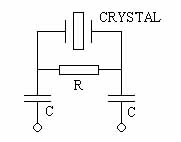
The diagram on the right shows a typical crystal oscillator circuit. It consists of a quartz crystal of the required frequency, a high value resistor, and two small value ceramic capacitors - one from each leg of the crystal to ground. The quartz crystal can be identified as a small, flat, silver metallic can, approximately 12mm tall, with its operating frequency stamped either on the side or top. The resistors and capacitors may either be of conventional through hole type, or more frequently nowadays, small surface mount components.
The passive components shown are connected across a CMOS inverter which is usually provided as an integral part of the chip that requires the oscillator, e.g. pins 11 and 12 of a Philips SAA7220 digital filter. Where a dedicated inverter is not made available, then most manufacturers create the oscillator using one of the gates in the common 74HCU04 hex inverter chip.
The main problems of this type of oscillator are caused in three areas.
- The first is that the sine wave it produces has a relatively slow rise time.
- This is not a problem in itself, but when associated with the second problem of noise on the power supply, gives a combination that varies the time at which the sloping clock signal appears to cross the threshold voltage of the device that is being clocked (as shown in the diagram below). This ‘window of time’ is one of the key mechanisms that produces clock generated jitter.
- The third problem is of jitter actually generated within the clock itself.
Clock 4 tackles these problem areas by providing a very stable, active clock oscillator module. At +/-5 ppm it is highly accurate producing a square wave with extremely fast rise and fall times of 4 nano seconds, thus greatly reducing the window of time available for the generation of jitter. It is also provided with it’s own on-board low noise voltage regulator supplemented with wideband capacitive decoupling to reduce the noise even further.
As well as reducing power supply related jitter, another, but equally important effect is the reduction of data related jitter. It has been shown by using spectral analysis, that a reduction of five times’ data related jitter is possible by the inclusion of a ‘Clock 4 System’ in a player that has recorded high levels of this form of jitter.
Players that have exhibited relatively low levels of data related jitter have shown a virtual elimination with a ‘Clock 4 System’ fitted.
Because the clock is an active rather than a passive circuit, it requires a power supply capable of providing sufficient current. Typically the 11.2896MHz version requires 22mA of DC current, and the16.9344MHz version requires 28mA. For this reason it is important that the Clock 4 is provided with a dedicated power supply. This supply not only provides the required amount of current necessary, but isolates any clock generated noise from the rest of the player’s circuitry.
It must be emphasized that clock related errors and jitter are not the only problems associated with digital audio electronics and CD replay - optical performance of the laser pick up, error correction, mechanical integrity and quality of the recordings and even the discs themselves all play a crucial part.
Why is it that CD player manufacturers have not woken up to the fact and fit more accurate clocks to their own machines? The answer is usually down to cost. Why should a manufacturer fit a better clock when the one they use already complies to the ‘normal’ industry benchmark. A high performance clock would take their product to the next price point, making it uncompetitive.
Fitting a high performance clock system to your player will improve many areas of the overall performance.
It will enable the decoding of digital information from a CD to be a much more accurate process, allowing the reproduction of all the nuances and subtleties in music that inaccurate clocks destroy. The sonic advantages of reducing jitter are many, including reduced phasiness, glare and harshness, with an increase in dynamics, resolution and soundstaging.
If you own an older machine that you are considering trading in for a new one, you would probably get better results and save money by upgrading the existing player. This does not mean to say that new machines do not upgrade well - most of them do.
Trichord Research, or a Trichord Research Dealer will undertake to fit ‘Clock 4′ or ‘Clock 4 Systems’ upon request.
The ‘Clock 4′ module and ‘Clock 4 Power Supply’ are available separately.
It is possible to fit just the ‘Clock 4′ module and run it from the players own power supply, and then fit the ‘Clock 4 Power Supply’ at a later date. Available in kit form complete with instructions for the technically competent. (We strongly advise that you let us, or one of our dealers carry out the modification if you have any doubts whatsoever).
When ordering a kit please state either the players make and model, or the frequency of ‘Clock 4′ required.
